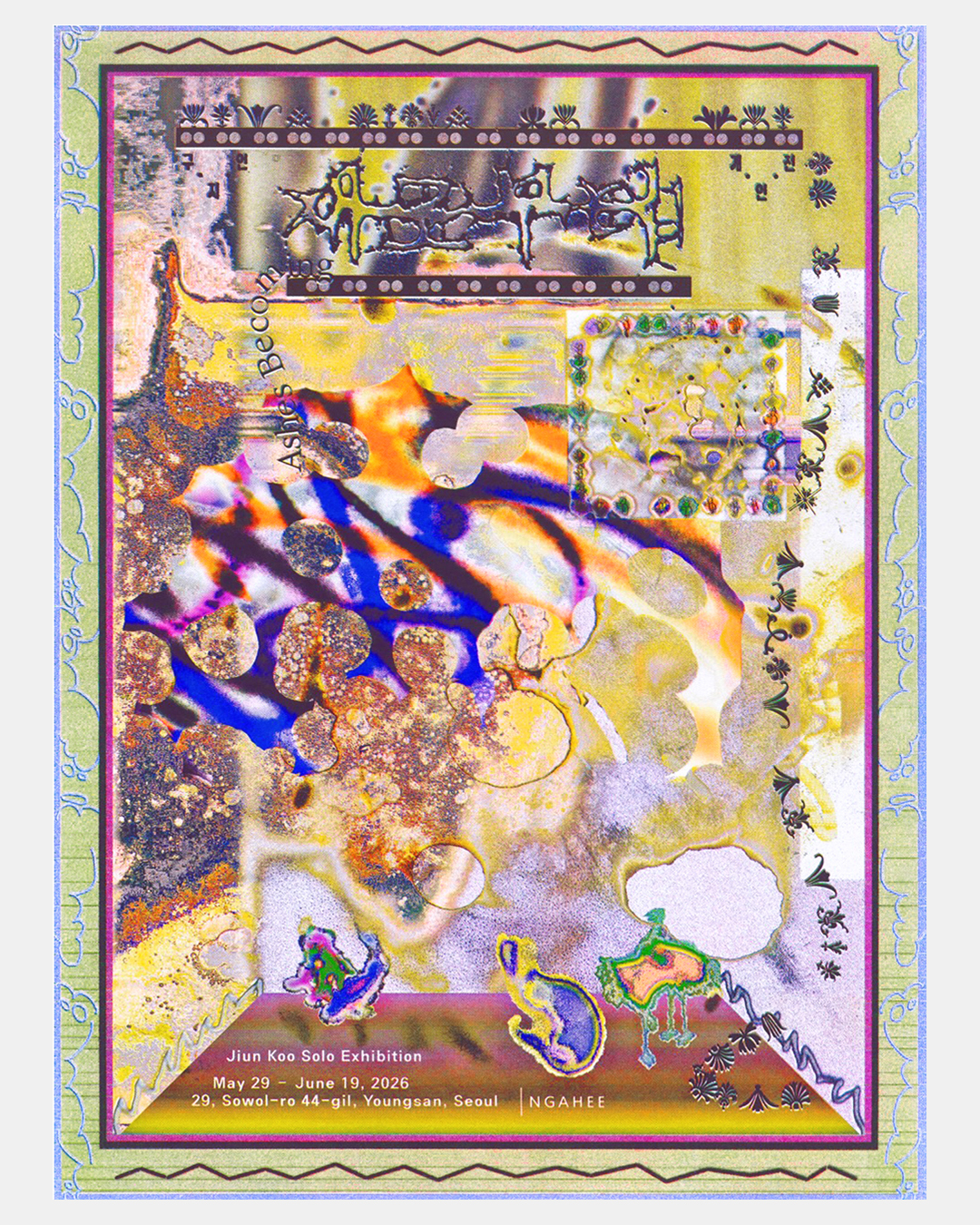
재로부터: Ashes Becoming

"재는 끝난 것들의 흔적이 아니라, 다음 형상이 시작되는 물질이다."
전시장 유리창 너머, 회화 사이로 연수목(椽樹木)들이 천장으로부터 내려와 있다. 벼락을 맞은 감태나무로, 한국에서는 전통적으로 불로 지져 껍질을 벗기고 옻을 발라 지팡이로 삼아온 재료다. 구지언은 이 나무들을 뱀매듭으로 직접 밧줄에 연결해 매달았다. 멀리서 바라보면 그중 한 쌍의 연수목이 회화 〈땅바다 중성신〉 뒷면을 받치며 위아래로 뻗어 있어, 캔버스 속 인물의 두 다리처럼 보인다. 회화와 설치가 하나의 신체를 이루는 순간, 공간은 신당(神堂)에 가까워진다. 그러나 이 신당이 모시는 것은 어떤 완결된 신이 아니다. 그것은 타오르고, 소진되고, 다시 남겨지는 과정 그 자체다.
구지언의 개인전 《재로부터》는 형태를 잃은 이후의 몸을 다룬다. 전작들이 다수의 중성신을 소환하는 판테온에 가까웠다면, 이번 전시는 그 신들이 모두 타고 난 뒤의 상태에서 시작한다. 이번 회화들은 침식되고 마모된 표면을 택한다. 뿌옇게 흐려진 형상, 밀어낸 듯 번진 색채, 불에 그을린 듯 탁해진 색조. 안료층은 형태를 고정하기보다 번지고 스며들며 육체의 윤곽을 흐린다. 구지언은 성별이 고정된 범주로 작동하는 세계 안에서 어느 한쪽에도 완전히 귀속되지 못하는 상태를 오래 경험해왔다. 정상성의 세계에서는 충분히 이탈해 있지만, 그렇다고 어디에도 온전히 속해 있지 못하는 이중 배제의 상태. 《재로부터》는 처음으로 그 윤곽선 자체를 지운다.
연수목은 이번 전시의 조각적 언어를 구성하는 핵심 오브제다. 벼락이라는 자연의 열을 통과한 나무를 공간에 드리우고, 표면에 뱀의 무늬와 얼굴을 직접 묘사해 나무를 뱀의 몸체로 삼았다. 각각의 연수목에는 쇠살모사, 유혈목이, 살모사의 이름이 붙었다. 나무 표면에는 그을리고 벗겨진 피부 같은 흔적들이 남아 있으며, 일부는 불에 탄 조직처럼 어둡게 침식되어 있다. 이 나무들은 이미 한 차례 소진된 이후 남겨진 신체의 잔존물에 가깝다. 작가는 그 불의 흔적 곁에 자신의 작업을 나란히 놓는다.
전시장 정면에 걸린 〈땅바다 중성신〉은 이번 전시의 축이다. 두 손을 골반에 얹은 인물의 상체는 갑각류의 외피와 지렁이 형태로 덮여 있어 신체의 성별을 가늠하기 어렵다. 이 형상들은 피부 위에 얹힌 것이 아니라 몸 안에서 투영되듯 겹쳐 보인다. 형상은 배경의 어두운 산화색과 붉은 토색 사이로 스며들며 경계를 잃어간다. 화면 하부로 내려갈수록 수중과 육지, 생성과 소멸의 이미지가 서로 침식하며 공존한다. 이 인물은 완성된 이상적 존재가 아니라, 기존의 몸이 소진된 이후 아직 형성 중인 존재처럼 나타난다. 형상이 배경과 뒤섞이며 형태를 잃어가는 과정 자체가 하나의 서술이 된다.
〈껍질들〉에서는 인간의 등 위에 악마꽃사마귀의 머리와 보석벌레의 외피가 겹쳐진다. 중요한 것은 곤충의 형상이 아니라 재질의 감각이다. 단단한 키틴질, 낯선 마디, 내부가 비쳐 보이는 얇은 외피. 구지언은 회화 이전에 특수분장가로 활동했다. 분장가는 타인의 피부 위에 레이어를 올리고 굳히며 새로운 얼굴을 만들어내는 사람이다. 이 경험은 〈껍질들〉에서 화면 자체의 논리로 되돌아오지만, 방향은 역전된다. 덧씌우는 것이 아니라 벗겨내는 것으로. 허물을 벗는다는 것은 이전의 자신을 부정하는 일이 아니라, 그 몸이 머물던 형태를 떠나는 일에 가깝다.
〈그릴로스–삼면괴상〉에서 세 개의 얼굴은 각각 다른 각도를 향하고 있으나 하나의 질량 안에 묶여 있다. 반투명한 안료층은 얼굴을 단단한 표면이 아니라 끊임없이 변형되는 막처럼 보이게 만든다. 그릴로스는 고대 그리스·로마에서 여러 개의 얼굴과 신체를 결합해 보석에 새기던 도상 형식으로, 얼굴들이 서로를 지우지 않은 채 동시에 존재하는 상태를 물질화한다. 테라코타처럼 소성된 표면은 굳어가는 석고이자 불 이후에 남겨진 탄화된 물질처럼 보인다. 얼굴은 자아를 설명하는 중심이 아니라, 여러 시간과 표정들이 겹쳐 남겨진 흔적이다.
〈껍질과 장(臟)〉과 〈안녕〉은 하나의 세트로 구성된 작업이다. 〈껍질과 장(臟)〉은 나무 프레임 양옆을 파내어 반으로 가른 암모나이트 화석을 삽입하고 표면을 갈아 마감한 추상 회화다. 억겁의 시간이 응축된 화석은 프레임 내부로 침입하듯 매장되어 있다. 안료는 내부에서 번지고 침식되며 화면 전체에 잔류하는 감각을 남긴다. 그 아래 설치된 〈안녕〉은 2020년에 캐스팅한 얼굴을 이번 전시를 준비하며 다시 페인팅한 조각이다. 코와 입, 턱의 일부만 남겨진 두 개의 얼굴 파편은 어긋난 채 결합되어 있다. 제목 '안녕'은 인사이면서 동시에 작별의 말이기도 하다. 두 작업은 탈피 이후 남겨진 외피, 혹은 이미 소멸이 시작된 신체의 흔적처럼 존재한다. 재로부터 다시 시작한다는 것은 외피를 새것으로 교체하는 일이 아니다. 그것은 안쪽에서부터 다시 빚어지는 것이다.
구지언의 작업은 성별 규범 바깥의 신체 감각을 직접적으로 설명하거나 재현하지 않는다. 화면 속 신체들은 인간의 육체와 곤충의 외피, 해양생물의 조직들이 뒤섞인 채 하나의 안정된 범주 안에 머물지 않는다. 이 몸들은 오히려 경계가 흐려지고 무너지는 순간에 출현한다. 작가는 그 상태를 하나의 명확한 정체성으로 제시하지 않는다. 대신 불안정하고 미결정적인 상태 자체를 유지한다. 그리고 바로 그 흔들림 속에서 아직 이름 붙여지지 않은 몸의 가능성이 나타난다. 형상이 흐려질수록 그 안에 잠재된 감각은 더욱 선명해진다.
구지언(b.1990)은 침식되고 변형되는 신체의 상태를 회화와 설치를 통해 탐구해왔다. 최근에는 한국 무속신앙의 중성신 도상과 특수분장 경험을 바탕으로, 인간·곤충·해양생물의 요소가 뒤섞인 혼성적 몸을 그려낸다. 작가에게 몸은 고정된 정체성이 아니라, 끊임없이 탈피하고 변화하는 상태에 가깝다.
Koo Jiun has long explored, in painting and installation, the body as a site of erosion and transformation. In recent works, drawing on the iconography of androgynous gods in Korean shamanism as well as Koo’s experience in special-effects makeup, Koo has imagined hybrid bodies in which human, insect, and marine forms interpenetrate. For Koo, the body is not a stable identity but a condition of continual shedding, mutation, and becoming.
“Ash is not the trace of what has ended; it is the matter from which the next form begins.”
Beyond the gallery’s glass, branches of thunder-struck Lindera glauca descend from the ceiling among the paintings. The term refers here to gamtae trees struck by lightning and traditionally seared by fire, stripped of their bark, coated with lacquer, and fashioned into walking staffs. Koo has knotted these woods to ropes by hand, using serpent knots, and suspended them in the air. From a distance, one pair appears to brace the reverse of Androgynous God of Terramaris, extending upward and downward like the two legs of the figure within the canvas. At the moment painting and installation cohere into a single body, the space begins to resemble a shrine. Yet this shrine does not enshrine any completed god. What it holds is the process itself: burning, expenditure, and what remains to begin again.
Koo Jiun’s solo exhibition Ashes Becoming turns toward the body after the loss of form. If Koo’s earlier works resembled a pantheon summoning multiple androgynous gods, this exhibition begins after that pantheon has burned away. The paintings assume eroded and abraded surfaces: forms blurred into haze, colors smudged as though pushed aside, tones dulled as if by scorch marks. Layers of pigment do not secure the figure; they bleed, seep, and loosen the body’s contours. Koo’s practice proceeds from a long experience of living in a world where gender operates as a fixed category, while belonging fully to neither side of it. It is a condition of double exclusion: already displaced from the world of the normative, yet at home nowhere else. For the first time, Ashes Becoming erases the contour line itself.
Thunder-struck Lindera glauca forms the central object vocabulary of the exhibition’s sculptural language. Wood that has passed through the natural heat of lightning is suspended through the space; its surfaces are painted with serpentine patterns and faces, transforming each piece into the body of a snake. Each is named after a species—the Ussuri pit viper, the tiger keelback, and the viper. On their surfaces remain traces that resemble scorched, flayed skin; in places, they darken into erosions like charred tissue. These woods are less objects than remnants of a body left behind after a prior expenditure. Koo places Koo’s own work alongside these marks of fire.
Mounted on the gallery’s front wall, Androgynous God of Terramaris anchors the exhibition. With both hands resting on the pelvis, the figure’s upper body is covered in crustacean carapace and wormlike forms, rendering its sex indeterminate. These forms do not sit on the surface of the skin; rather, they appear layered as if projected from within the body. The figure seeps between the background’s dark oxidized hues and red earthen tones, losing its edges. Toward the lower part of the canvas, images of water and land, of coming-into-being and passing-away, erode one another and coexist. This is not a perfected or ideal being, but one still in formation after the previous body has been spent. The very process by which the figure mingles with the background and loses its form becomes a narrative in itself.
In Molts, the head of a devil’s flower mantis and the carapace of a jewel beetle are layered over a human back. What matters is not the iconography of the insect but the sensation of matter: hard chitin, unfamiliar segmentation, a translucent shell through which the interior seems to show. Before Koo became a painter, Koo worked as a special-effects makeup artist. Such an artist builds layer upon layer on another’s skin, allowing materials to set into a new face. In Molts, that experience returns as the logic of the painting itself, but its direction is reversed. Not application, but removal. To shed one’s skin is not to negate the former self; it is to depart from the form in which that body once dwelled.
In Gryllos - Three-Faced Aberration, three faces turn in different directions yet remain bound within a single mass. Translucent layers of pigment make the faces appear not as fixed surfaces but as membranes in continuous deformation. The gryllos, an iconographic form from Greco-Roman antiquity in which multiple faces and bodies were combined and engraved into gemstones, materializes a condition in which faces coexist without effacing one another. Fired like terracotta, the surface reads at once as setting plaster and as charred matter left after fire. The face is no longer the center that explains the self. It is a trace left by many times and expressions layered over one another.
Shells and Fields and Annyeong form a paired work. Shells and Fields is an abstract painting in which the two sides of a wooden frame have been hollowed out, set with ammonite fossils split in half, and finished by grinding the surface. The fossil, a condensation of immeasurable time, seems buried within the frame as though intruding into its interior. Pigment spreads and erodes from within, leaving a residual sensation across the whole surface. Installed below it, Annyeong is a sculpture based on a face cast in 2020 and repainted in preparation for this exhibition. Two facial fragments, with only parts of the nose, mouth, and chin remaining, are joined out of alignment. The title Annyeong is a Korean greeting that encompasses both hello and goodbye, functioning here as an invocation of both arrival and departure. The two works exist like a shell left after molting, or like traces of a body whose dissolution has already begun. To begin again from ashes is not to replace the shell with a new one. It is to be formed anew from within.
Koo Jiun’s work neither explains nor directly represents the sensation of a body outside gender norms. The bodies on Koo’s canvases, where human flesh, insect carapace, and marine tissue intermingle, do not settle within any stable category. Rather, they appear at the moment when boundaries blur and collapse. Koo does not offer this state as a clear identity. Instead, Koo sustains the unstable and indeterminate condition itself. It is within that wavering that the possibility of a body not yet named emerges. The more the form blurs, the sharper the sensation latent within it becomes.
Text by In Gahee